


The Wild Olive: Resilience, Beauty, and Legacy in One Tree
Updated: Sep 9, 2025
Why Olea africana belongs in every Western Cape garden that values heritage, ecology, and timeless design.
What is the Wild Olive?
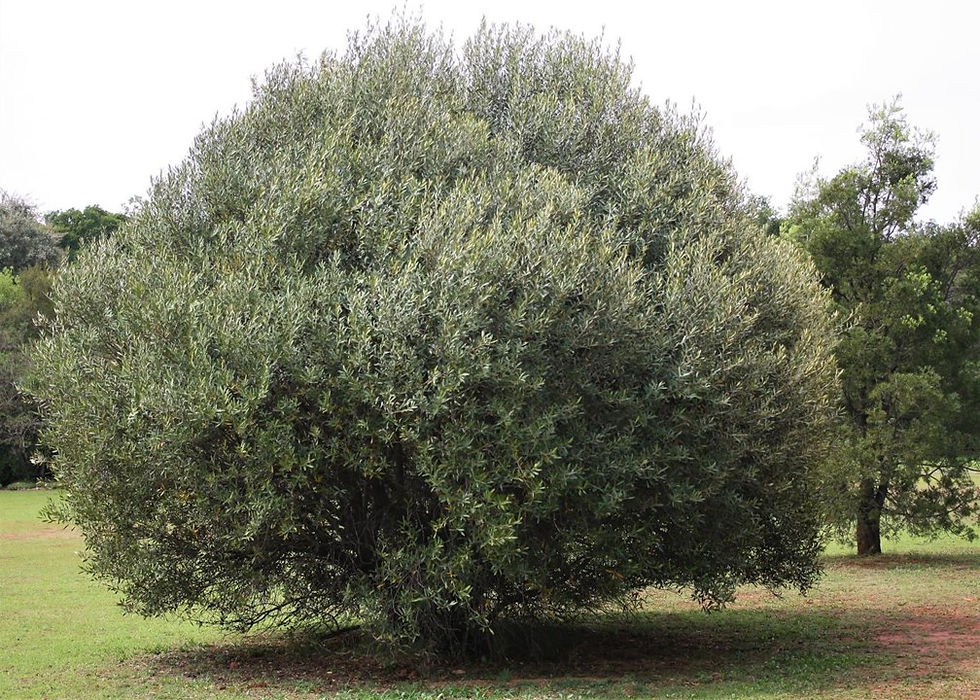
The Wild Olive (Olea europaea subsp. africana) is not just another indigenous tree. It’s a symbol of resilience - tough, slow-growing, long-lived, and deeply woven into Southern African history.
This evergreen beauty holds space in both the wild fynbos margins and the thoughtfully curated gardens of conscious homeowners.
If you’ve ever spotted a compact, silvery-leaved tree growing confidently on a windswept hill or near a stone wall in the Overberg, chances are you’ve already met her.
Why We Recommend the Wild Olive
At Overberg Arborists, we often recommend the Wild Olive for one simple reason:
it just works - for your land, your lifestyle, and the environment.
Here’s what makes it a no-brainer:
Native to the region: It's adapted to our soils, our rainfall, and our rhythms.
Drought-tolerant: No guilt. No hosepipe needed after year two.
Evergreen and low maintenance: You plant it, shape it early, and it thrives.
Wildlife friendly: Offers food and nesting for local birds and insects.
Long lifespan: This is a legacy tree. One your kids will still be enjoying decades from now.
Botanical Breakdown (At a Glance)
Characteristic | Description |
Scientific Name | Olea europaea subsp. africana |
Common Name | Wild Olive / African Olive |
Height | 5–10 metres (sometimes more in perfect sites) |
Growth Rate | Slow to moderate |
Form | Rounded, compact crown; often multi-stemmed |
Leaves | Narrow, leathery, dark green with silvery undersides |
Fruit | Small, black, hard drupes (inedible) |
Root System | Deep, non-invasive |
Bark | Deeply fissured, grey to brown |
Where Does It Grow Best?
The Wild Olive thrives almost anywhere in the Western Cape, but especially in:
Rocky hillsides
Coastal plots
Dryland gardens
Slopes or drainage lines
Sites exposed to wind or sun
Avoid waterlogged or saline areas. It likes space, sunlight, and freedom from soggy feet.

What Does It Offer Ecologically?
This tree supports biodiversity in quiet, powerful ways:
Birds love its fruit - think bulbuls, mousebirds, starlings.
Canopy shelter creates safe nesting sites.
Bark and leaf litter support micro-invertebrates.
Small flowers, though not showy, still support pollinators.
It's not a flashy pioneer - it's a slow-and-steady player in healthy, long-term ecosystems.
Ideal Uses for the Conscious Homeowner
If you’re planning a low-maintenance, water-wise, wildlife-friendly garden, the Wild Olive earns a starring role.
You can use it as:
A feature tree in a gravel courtyard or indigenous landscape
A structural backdrop in a fynbos-style or modern dry garden
A hedge alternative, planted with spacing for sculptural growth
A legacy tree — something that outlives trends and weather patterns
Planting Tips (Don’t Overcomplicate It)
Soil: Adaptable to sand, loam, or gravel. Just avoid clay-heavy or waterlogged zones.
Sun: Full sun is essential - Wild Olives don’t do well in deep shade.
Water: Water only during the first 12–18 months. After that, it’s fully self-sufficient under
average Western Cape rainfall.
Spacing: Give each tree breathing room. 3–5 metres minimum from other trees or structures.
Fertiliser: Not needed. In fact, too much fertiliser can cause leggy, distorted growth.

Pruning & Management
Wild Olives don’t require constant trimming — but early shaping is smart.
Here’s how to get it right:
In year one or two, establish a strong central stem (or leave multi-stemmed if you want a bushier form).
Remove any double leaders to prevent structural issues later.
Crown-thin only to improve airflow or reduce density.
Avoid hard topping or aggressive shaping — this tree recovers slowly.
Best time to prune: Winter or early spring before new growth.
Problems? Hardly.
This is one of the lowest-maintenance indigenous trees you can plant. Still, in stressed conditions you might see:
Issue | Cause | Severity |
White scale | Poor airflow or overwatering | Cosmetic |
Sooty mould | From scale/aphid activity | Minor |
Dieback | Wet feet or poor drainage | Preventable |
As always, the fix is not pesticide — it’s better planting choices and proper early care
How It Differs from the Cultivated Olive
Don’t confuse africana with the European olive (Olea europaea europaea) planted for fruit or oil.
Feature | Wild Olive (africana) | Cultivated Olive (europaea) |
Indigenous? | Yes | No |
Fruit | Small, inedible | Large, edible |
Growth style | Compact, natural form | Often pruned single-stem |
Leaf underside | Silvery | Dull grey-green |
Biodiversity value | High | Low (in comparison) |
If you’re planting for the environment, choose africana - every time.

Timber, Symbolism, and Cultural Role
The wood of the Wild Olive is dense, durable, and revered - used historically for:
Carvings
Furniture
Fence posts
Tool handles
It’s slow-growing, which makes its timber all the more precious. Culturally, Wild Olives were often planted near kraals or used in traditional medicine, embodying protection, legacy, and resilience.
Final Thoughts
The Wild Olive is not showy, it’s sovereign.
It won’t grow fast, but it will last. And it doesn’t just fit into your garden; it becomes a part of its long-term identity.
For the conscious homeowner who wants to invest in something real, ecological, and enduring… the Wild Olive is an easy yes.
Need Help Choosing Trees That Actually Thrive?
We’re local, trusted arborists who understand the Western Cape’s soils, winds, and water patterns - and we’ll never recommend something that won’t work for you.
🌱 Or check out our “Guide to Trees in the Western Cape” — available now as a free download
Comments