


More Than Just Cutting Trees
Updated: Aug 31
André Pietersen on building Overberg Arborists, becoming an ISA Certified Arborist, and why professional tree care demands knowledge, humility and forethought.
For André Pietersen, tree work was never simply about cutting branches or felling timber. What began with working alongside his father gradually developed into something far more demanding: a profession requiring observation, judgement, responsibility and a willingness to keep learning.
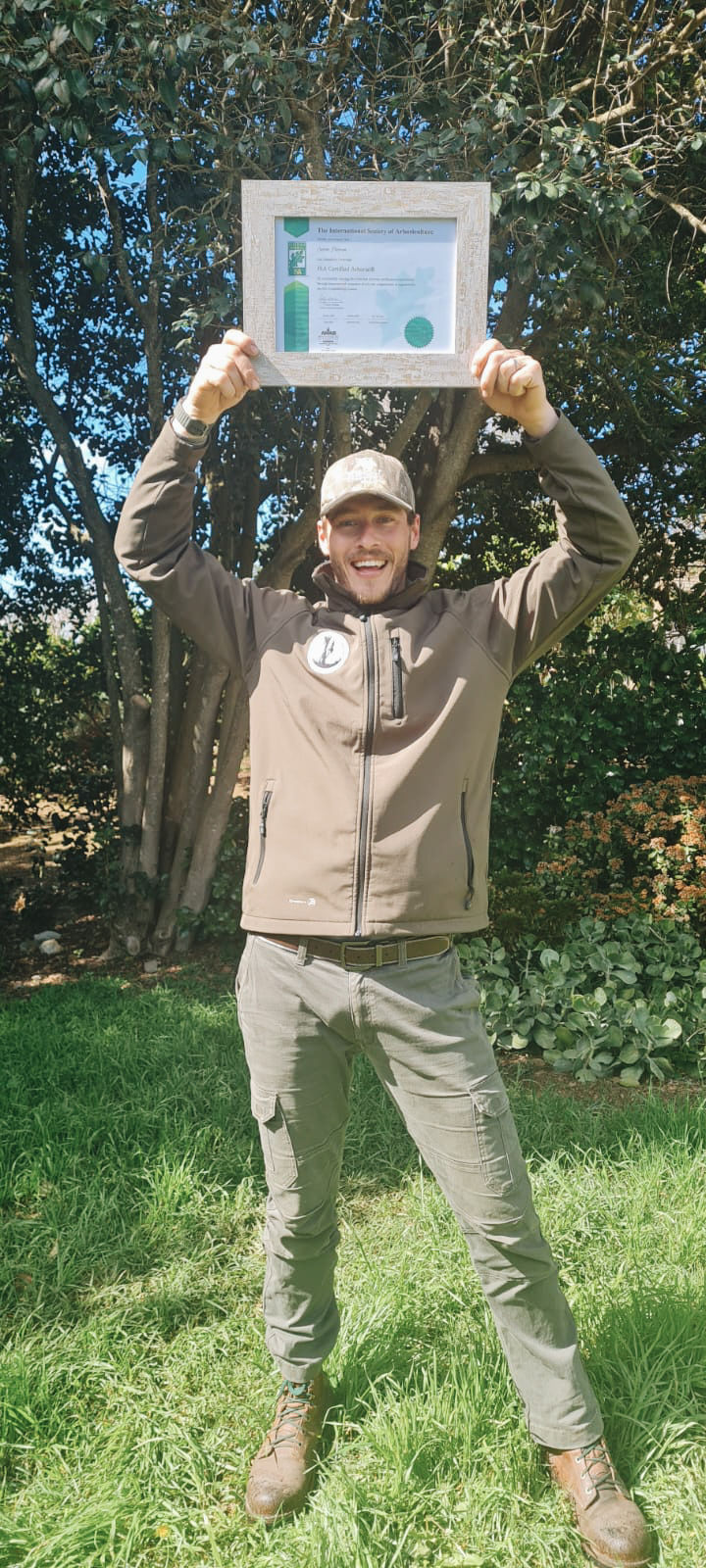
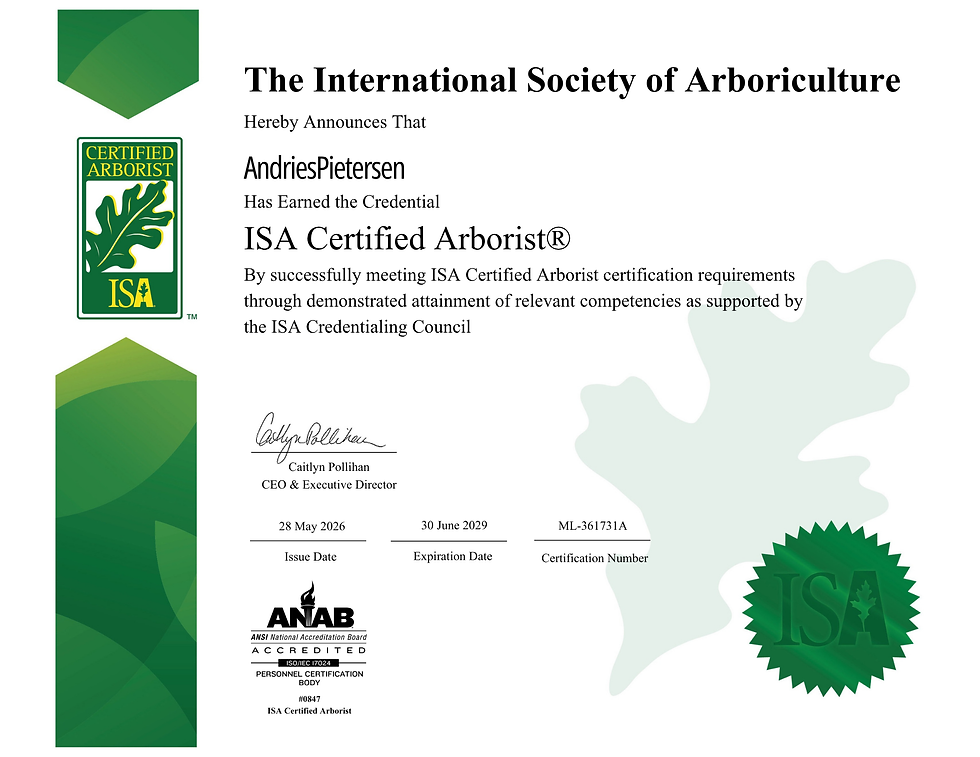
Today, André is the co-founder and lead arborist of Overberg Arborists (Pty) Ltd and, as of June 2026, an ISA Certified Arborist. But the qualification did not mark the beginning of his career. Rather, it represents another step in a journey that has already been years in the making.
A Career That Grew From the Forest
André's introduction to tree work came through working alongside his father, also André, on their family mountain farm. With a large forest consisting mainly of Radiata Pine, the family invested in a mill and began milling timber.
It happened at an important point in André's life. He had recently left his studies at Stellenbosch University without completing his degree and was searching for something to which he could genuinely commit himself. As he puts it, he was "really looking for something to dedicate my life to."
Tree work gave him that direction.
From the beginning, arboriculture never felt like simply another job. There was too much to learn and too much to understand. The early years included plenty of trial and error, but André says he found he had a natural inclination not only for doing the physical work, but also for understanding why particular approaches to tree work were necessary.
Overberg Arborists began to take off as a professional company around the start of the COVID-19 period. As the business developed, so did André's understanding of what professional tree care could - and should - look like.
Seeing a Higher Standard
Around six years before earning his certification, André began paying closer attention to arboricultural work being practiced internationally, particularly in the United States, Europe, Australia and New Zealand.
The standard of work he saw made an impression on him. More importantly, it highlighted what he believed was an opportunity to raise the standard locally. André recalls seeing "a big gap in the standard of work that was being executed here."
That realisation became one of the driving forces behind his decision to pursue ISA certification.
It was not a quick process. André first considered becoming an ISA Certified Arborist six or seven years before ultimately earning the credential. Rather than rushing into it, he felt he needed enough practical experience in the field to support what he was learning academically.
At the same time, life was busy. There was a growing business, two children, and a homestead to manage. Once André committed himself fully to his ISA studies, the process took approximately two years, culminating in his certification in June 2026.
Why Experience Matters
Looking back, André believes the years spent working practically with trees were an important part of preparing for the ISA examination.
Many of the questions, he explains, are based on real situations and scenarios an arborist could encounter in the field. This is one reason he values the practical experience required before someone can qualify to sit for the certification examination.
"I feel adequate time in the field helps a lot towards the ISA credentials," André explains, particularly because so much of the knowledge eventually needs to be applied outside a textbook.
Interestingly, the greatest challenge was not necessarily learning the material. It was not knowing exactly what the examination would look like or what would be asked.
Resources and advice shared by other arborists online helped, although André admits he probably studied considerably more than he needed to. In retrospect, that may have been a good thing. The knowledge he gained gave him something beyond a qualification: greater confidence in his own professional judgement.
That confidence becomes particularly important when assessing tree risk, identifying defects, and thinking beyond the immediate job to consider a tree's future and which interventions could give it the best chance of remaining healthy.
Learning to Work With Defects, Not Simply Remove Them
One of the most valuable parts of André's studies was developing a deeper understanding of tree defects and the options available for managing them.
A defect does not necessarily mean that a large part of a tree needs to be cut away, or that the tree itself automatically needs to be removed.
Through his studies, André expanded his knowledge of mitigation pruning, cabling, bracing and other management techniques that may, in appropriate circumstances, allow a tree to continue living with a defect without it developing into an unacceptable structural or safety concern.
This represented an important shift in thinking: the objective is not always to remove the problem, but sometimes to understand it, manage it and allow the tree to adapt.
Yet for all the knowledge gained through formal study and years in the field, André believes one of the most important qualities an arborist can develop is humility.
"There are so many things I learned during my studies, and I am still learning new things every day," he says. For André, acknowledging how much there is still to learn encourages careful observation and honesty with clients about what can be seen, what is known, and what his professional opinion is.
Tree Cutting Versus Arboriculture
When asked what separates tree cutting from arboriculture, André sums it up in two things: "forethought and knowledge of the consequences."
The distinction is significant.
Anyone can look at a branch and decide it needs to come off. Professional arboriculture requires thinking about what happens after that cut is made.
How will the tree respond? What will happen to its structure? Is removing the branch actually necessary? Could the intervention create another problem several years from now?
André believes an arborist must be prepared to question a requested intervention when it is not in the tree's best interests. The job is not simply to satisfy the immediate request, but to consider the biological, structural and safety consequences of the work being recommended.
Certification has strengthened that sense of responsibility within Overberg Arborists. The company now includes its ISA credential and declaration of standards on quotations, something André believes has influenced how clients perceive both his professional opinion and the business.
For him, the credential demonstrates that time has been invested in acquiring the knowledge and skills necessary to practice the trade at a recognised professional standard.
When Good Intentions Can Harm a Tree
One of the most common mistakes André sees homeowners make in the Western Cape is removing too much live foliage from a tree at once.
It is often done with good intentions. A tree may have become too large, a homeowner may want more sunlight or a better view, or someone may simply believe that cutting a tree back hard will encourage healthier growth.
The consequences, however, can be very different.
Live foliage plays an essential role in a tree's ability to produce and manage energy. André warns that excessive removal can place considerable stress on a tree and contribute to decline. Once weakened, additional pressures such as pests, pathogens, and environmental stresses can make recovery increasingly difficult.
The lesson is an important one for homeowners: more pruning does not automatically mean better tree care.
And what happens above ground is only part of the picture.
André considers soil and root health fundamental to the overall health of a tree. As he explains it, "the soil is the growing medium and the tree is the fruit of the soil."
A tree cannot be separated from the environment supporting its roots. When soil health deteriorates through compaction, disturbance, contamination, or other pressures, the tree itself may struggle to thrive regardless of how much attention is given to its canopy.
Preserve or Remove? The Decision Is Rarely Simple
Deciding whether a tree can be retained or needs to be removed is another area where professional judgement becomes important.
André's approach is generally to retain older trees wherever this can be done responsibly. Mature trees can have significant environmental, landscape and sentimental value, and removal should not automatically be the first response to a problem.
There are, however, situations where the likelihood and potential consequences of tree failure become serious enough for an arborist to recommend removal.
Even then, André is careful about the distinction between recommendation and decision. An arborist can assess the tree, explain the risks and provide a professional recommendation, but the final decision generally rests with the property owner or, where applicable, the relevant authority.
Balancing the Client, the Law and the Tree
One of the more difficult parts of professional tree care is balancing what a client wants with what is actually appropriate for the tree.
André encounters this particularly when homeowners want trees heavily pruned to improve a view. The situation becomes more complex when protected trees such as Milkwood trees are involved, where pruning and other forms of disturbance may be subject to legal restrictions.
Clients have, after all, called an arborist because they want a problem solved. André believes the responsibility of the arborist is to find the best possible solution without ignoring the long-term health of the tree or the requirements that may apply to it.
Fortunately, he finds that most clients who deliberately choose to employ an arborist genuinely care about their trees.
"If you give your professional opinion and you explain the consequences of what they initially wanted," André says, clients will generally understand why a more sustainable approach may ultimately be the better option.
It turns what could have been a disagreement into something more valuable: an opportunity to educate.

Global Knowledge, Local Trees
The Western Cape has its own distinctive climate, soils and tree species, but André believes the fundamental biological principles behind good arboriculture remain widely applicable.
Trees differ between species and environments, but many of the underlying principles governing pruning, growth responses and tree biology can be applied internationally. The real skill lies in understanding those principles well enough to adapt them to the particular species, environment and tree standing in front of you.
It is also why André does not see certification as the end of his education.
For him, arboriculture is a profession in which there will always be something new to observe, question and learn.
South African Tree Care Needs More Collaboration
When asked what he believes the South African tree-care industry needs more of, André's answer is not more equipment, more businesses or more competition.
It is collaboration.
He would like to see stronger relationships between tree-care professionals and companies, with greater willingness to communicate and share knowledge rather than viewing everyone else in the industry simply as competition.
André believes better collaboration could ultimately benefit everyone involved; arborists, tree-care businesses, clients and, most importantly, the trees themselves.
"I think we can do a lot more to collaborate and form better relationships in the industry," he says. In his view, this would help create "a better environment for our trees and for clients in general" while raising the overall standard and quality of work.

Investing in What You Do
If there is one message André wants people to take from his journey, it extends beyond trees.
Invest in your trade and continue learning.
For André, becoming an ISA Certified Arborist was never simply about earning a credential. It was an opportunity to challenge what he already knew, expand his understanding and hold himself to a higher professional standard.
"I believe it is very important to upskill yourself in your trade and invest in yourself as a professional," he says. Doing so creates confidence, but it also creates responsibility: the more you know, the greater the standard you should expect from your own work.
Perhaps the thought that best captures André's approach to arboriculture comes from his acknowledgement of just how much there still is to learn.
"I think we know so little about the world around us," he says, "it is very important that what we do know, we share with other people."
For André, whose career began working alongside his father and has grown into leading a professional arboricultural business, that willingness to keep learning - and to pass that knowledge on - may be what separates simply working with trees from making them your life's work.
Comments